


Is Home Title Locking a Scam? What the FTC Says
The FTC calls it "not a lock at all." Learn what Home Title Lock actually does, what regulators say, and what homeowners should do instead.
If you watch late-night television or listen to talk radio, you have likely seen the alarming advertisements: a criminal can steal your home's title out from under you, and you need to buy "title lock" protection immediately. But is Home Title Lock a scam, or is it a necessary service for homeowners? The answer is more nuanced and more important than the ads let on.
Table of Contents
What Is Home Title Locking?
Home Title Locking is a subscription service that monitors your county's property records and alerts you if a new document, such as a deed, mortgage, or lien, is filed against your home. The company markets its service as a way to prevent deed fraud, a crime where a scammer forges your signature on a deed to transfer ownership of your property to themselves or a fake LLC.
The service costs approximately $15 to $20 per month ($180 to $239 annually). In exchange, the company promises 24/7 monitoring of your title and access to a team of "restoration experts" if fraud occurs. The company is headquartered in California and is one of the largest providers in this category, relying heavily on endorsements from prominent conservative media figures to sell its product.
Is Title Lock a Scam?
The word "scam" implies an illegal operation that takes your money and provides nothing in return. By that strict definition, Title Lock is not a scam. They do actually monitor public records and send alerts. However, many legal experts, consumer advocates, and government regulators argue that the service is highly misleading, overpriced, and relies on fear-based marketing to sell a product that does not do what consumers think it does.
The primary issue is the name itself: Title Lock. The service does not "lock" your title. It is legally impossible for a private company to prevent a county recorder's office from accepting a filed document. If a scammer submits a forged deed that meets the county's formatting requirements, the county clerk must record it. Home Title Lock simply sends you an alert after the fraudulent document has already been filed and entered into the public record.
What the FTC and Regulators Say
Government agencies have taken a strong, public stance against the marketing tactics used by title lock companies.
In August 2024, the Federal Trade Commission (FTC) issued a consumer alert specifically addressing these services, stating bluntly: "Title lock insurance is not title insurance... and it's not insurance at all." The FTC warned consumers that the ads are "just a ploy to scare you" and clarified that the service would only notify you after your title had already been transferred to someone else without your authorization.
The Texas Attorney General Investigation
In January 2023, Texas Attorney General Ken Paxton initiated a civil investigation into Home Title Lock under the state's Deceptive Trade Practices Act. The Attorney General's office issued a Civil Investigative Demand (CID) requiring the company to substantiate its advertising claims. Paxton stated: "I won't tolerate false, misleading, or deceptive advertisements targeted to any Texas consumers, especially Texas seniors. If Home Title Lock is misrepresenting its services or the need for its services, I will put a stop to its unlawful behavior."
The California City Attorneys Subpoena
In April 2023, City Attorneys David Chiu (San Francisco) and Mara W. Elliott (San Diego) issued a joint subpoena to Home Title Lock. They accused the company of manufacturing a "home title theft" crisis to stir up fear among elderly homeowners. San Diego City Attorney Mara W. Elliott did not mince words, stating: "Home Title Lock targets and preys upon elderly Californians whose homes are their chief source of financial security. It convinces its customers that they will wind up penniless if they do not invest in services they do not need. Home Title Lock's conduct is not just illegal; it is unconscionable and cruel."
What Real Customers Say (BBB & Trustpilot)
Beyond government regulators, actual customers have voiced significant frustration with the service. A review of the Better Business Bureau (BBB) and Trustpilot reveals a consistent pattern of complaints regarding billing, cancellation difficulties, and the service failing to perform as expected.
Here are verbatim quotes from real customers who felt misled by the service:
"This is ridiculous and smells like a scam. Not a good way to do business. I live on a fixed income and $199.00 is a lot of money. I dont recommend Home Title Lock."
Verified Customer Complaint via BBB.org
"Home Title Lock is a scam, please be aware and stay clear. I called to cancel the service as they charged my credit card that had already expired. The person in customer service was rude and refused to refund my money."
Verified Customer Review via BBB.org
"Home title lock is being difficult in cancelling my title monitoring service. They only re-imbursed 1 month so far and just charged another month after in email they said it was cancelled."
Verified Customer Complaint via BBB.org
"Last week we received a bill (paper) from HOME TITLE LOCK indicating we owe them $596.00 for a 4-year subscription and they included my husbands name and our address... We never signed up for this."
Verified Customer Complaint via BBB.org
The recurring theme across these complaints is that the company uses aggressive billing tactics and makes cancellation difficult, all while providing a service that many homeowners do not fully understand until it is too late.
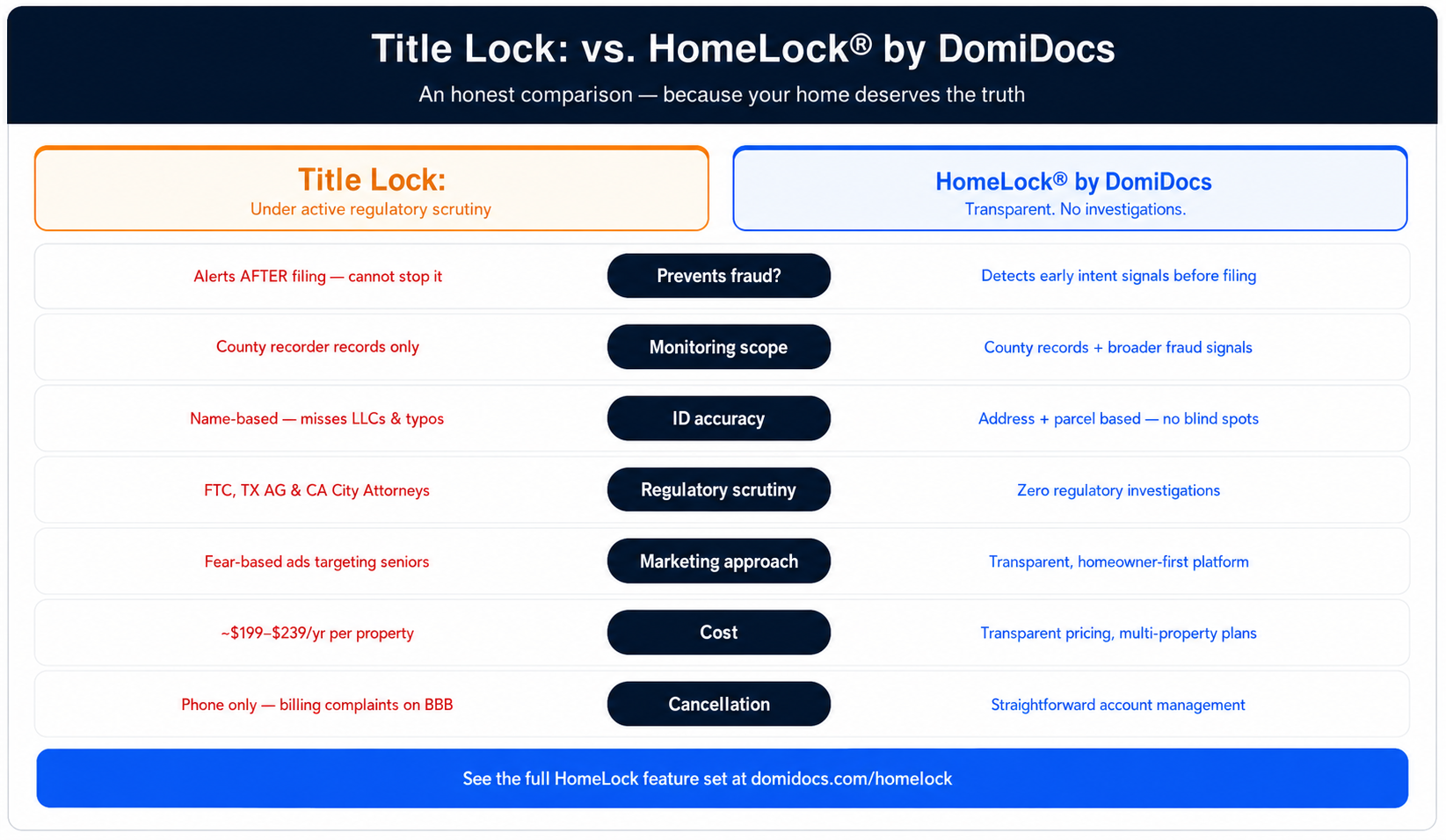
Title Lock vs. HomeLock®
To understand why Title Lock falls short, it helps to compare it to a comprehensive property protection platform like DomiDocs' HomeLock®.
Worried about title fraud?
Enter your address to start a HomeLock® scan for title, deed, lien, sale, rental, parcel, and internet signals tied to your home.
Where Title Lock Services Fall Short
Beyond the misleading marketing and regulatory investigations, there are several practical reasons why paying for a standalone title lock service may not be the best use of your money.
- It Does Not Prevent Fraud: The service only alerts you after a document has been recorded. It cannot stop a fraudulent filing from happening.
- Fraudulent Deeds Are Legally Void: If someone forges your signature on a deed, that deed is void under the law. They do not actually own your home, and they cannot legally sell it or borrow against it. While clearing the forgery requires a quiet title action, which is expensive and time-consuming, you do not instantly lose your home.
- Name-Based Monitoring Blind Spots: Many basic title lock services monitor by name rather than by parcel number or address. If a scammer misspells your name or transfers the property to a fake LLC, the system may miss the fraudulent filing entirely.
- Free Alternatives Exist: Many counties now offer the exact same monitoring service at no cost to homeowners.
Title Lock vs. Title Insurance: Not the Same Thing
Do not confuse title lock services with title insurance. You purchase an owner's title insurance policy once at closing. It protects you against past defects in the title, such as an undisclosed heir, a forged deed in the chain of title, or an old mechanic's lien, that existed before you bought the property. Title lock is a monthly subscription that monitors for future filings. They serve entirely different purposes, and one does not replace the other.
Better Alternatives for Homeowners
If you are concerned about real estate fraud, you do not need to pay $200 a year for a basic monitoring service that relies on fear-mongering. Here is what you should do instead.
1. Sign Up for Free County Alerts
Check with your local county recorder or clerk's office. Hundreds of counties across the U.S. now offer free property fraud alert systems. You simply register your name and property address, and the county will email you automatically if any document is recorded against your property. This is the exact same core service that title lock companies charge for.
2. Check Your Records Manually
If your county does not offer a free alert system, you can periodically check your property records yourself. Most counties have online databases where you can search by name or parcel number for free to know if your house title is clear. You can also learn how to find out if someone filed a deed on your property using public records.
3. Use Comprehensive Property Fraud Protection (The HomeLock Difference)
If you want monitoring that goes beyond basic county record checks, look for a platform that provides transparency, actual protection, and no fear-mongering. DomiDocs' HomeLock® provides home title protection that is fundamentally different from basic title lock services.
Instead of just waiting for a fraudulent deed to be recorded, HomeLock® scans for real-world "intent signals" tied to your property, looking beyond just recorder databases to catch the early warning signs of fraud. It uses address and parcel-based protection to eliminate the blind spots caused by name misspellings or LLCs. Most importantly, HomeLock® provides AI-driven threat severity levels and actual, step-by-step resolution guidance when an alert is triggered. We don't sell fear; we provide a comprehensive tool to manage and protect your most valuable asset.
Frequently Asked Questions
Is Title Lock a legitimate company?
Yes, Title Lock is a real company that provides the monitoring services it outlines in its terms of service. However, it has faced significant scrutiny from the FTC, the Texas Attorney General, and city attorneys in California over its allegedly misleading marketing tactics. The BBB has also received multiple complaints about billing and cancellation issues.
Does title lock actually lock your title?
No. It is legally impossible to "lock" a property title. County recorders are required by law to record documents that meet statutory formatting requirements. Title lock services only monitor the records and alert you after a document has already been filed in the public record.
Can someone steal my house if I don't have title lock?
While deed fraud is a real crime, a forged deed is legally void. A scammer cannot legally take ownership of your home with a forged signature. However, clearing the forged deed from your title will require hiring an attorney and potentially filing a quiet title lawsuit, which is why early detection through free county alerts or comprehensive monitoring is strongly recommended.
What does the FTC say about home title locking?
In August 2024, the FTC issued a consumer alert warning that "title lock insurance is not title insurance, and it's not insurance at all." The FTC described the advertising as "a ploy to scare you" and reminded homeowners that they can check their title for free through their state's land records office.
Sources
- Federal Trade Commission. "Home title lock insurance? Not a lock at all." https://consumer.ftc.gov/consumer-alerts/2024/08/home-title-lock-insurance-not-lock-all
- Office of the Texas Attorney General. "Paxton Announces Investigation of Home Title Lock for Potentially Misleading Texas Consumers." https://www.texasattorneygeneral.gov/news/releases/paxton-announces-investigation-home-title-lock-potentially-misleading-texas-consumers
- City Attorney of San Francisco. "San Francisco and San Diego City Attorneys subpoena Home Title Lock over deceptive advertising." https://sfcityattorney.org/san-francisco-and-san-diego-city-attorneys-subpoena-home-title-lock-over-deceptive-advertising/
- Better Business Bureau. "Home Title Lock Complaints." https://www.bbb.org/us/fl/coral-springs/profile/threat-and-fraud-assessment/home-title-lock-0633-92030728/complaints
