

What is the 10 80 10 rule for fraud?
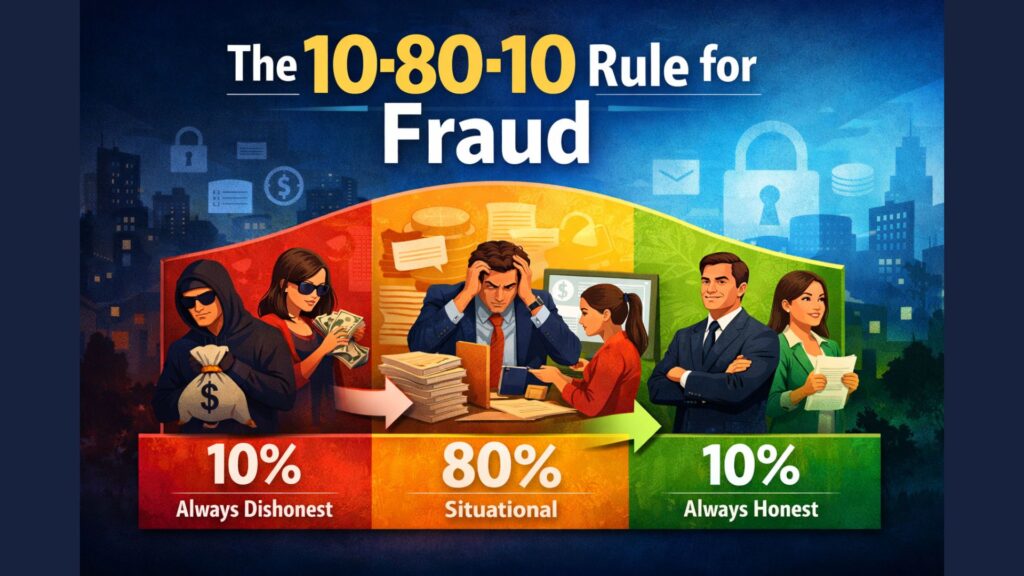
The 10-80-10 rule for fraud is a common ethics-and-risk framework that suggests roughly 10% of people won’t commit fraud under any circumstances, about 80% are situational (their behavior depends on pressure, opportunity, and rationalization), and about 10% will try to commit fraud when they see a chance.
The 10-80-10 rule for fraud is a common ethics-and-risk framework that suggests roughly 10% of people won’t commit fraud under any circumstances, about 80% are situational (their behavior depends on pressure, opportunity, and rationalization), and about 10% will try to commit fraud when they see a chance. It’s used to explain why practical controls and monitoring matter: most risk comes from the “situational” middle, not the extremes.1,2
Table of contents
What the 10-80-10 Rule Means
The 10-80-10 rule is a simple way to describe how different people tend to behave when they face temptation, weak oversight, or a chance to “get away with it.” It’s typically framed like this:
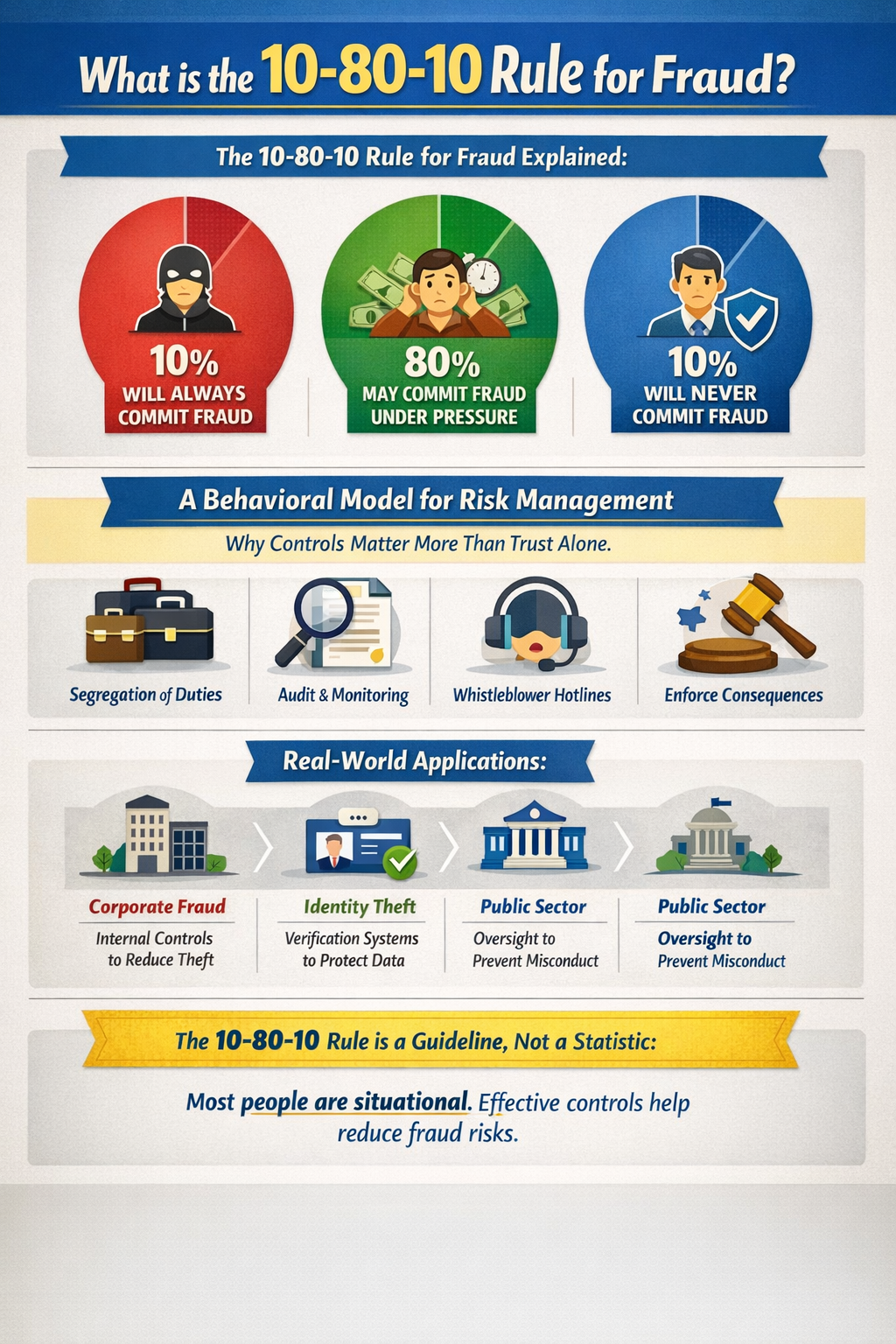
- 10% “always honest”: People who won’t commit fraud even if they could do it easily.
- 80% “situational”: People who are generally honest, but may cross the line when conditions make it feel justified, safe, or necessary.
- 10% “actively dishonest”: People who look for gaps in systems and opportunities to exploit them.
The 10-80-10 rule is a practical risk model, not a precise statistic. It helps teams design systems assuming most people respond to incentives and oversight—not just personal values.2
Used thoughtfully, the model encourages a key mindset shift: fraud risk management is mostly about environment (processes, access, oversight, and incentives) rather than trying to “spot bad people.”1
Why Fraud Teams Use It
Organizations use the 10-80-10 rule because it makes one point very clear: if you build policies only for the “worst 10%,” you may miss the biggest driver of everyday fraud risk—the middle 80%.1
This is why many fraud controls focus on:
- Reducing opportunity (tightening access, adding verification, limiting unilateral actions)
- Increasing detection (audit trails, alerts, independent reviews)
- Removing rationalization (clear policies, consistent consequences, ethical tone from leadership)
The goal isn’t to assume everyone is dishonest. The goal is to design workflows that make the “wrong choice” harder, riskier, and easier to catch—especially for situational fraud.
In homeowner contexts, the same logic applies to paperwork crimes like deed or title fraud. If you want a concrete example of how “opportunity” shows up in real life, see What Is Home Title Fraud and How Does It Actually Happen?
How It Connects to the Fraud Triangle
The 10-80-10 rule is often discussed alongside the fraud triangle, a widely used framework describing three conditions that tend to exist when fraud occurs: pressure, opportunity, and rationalization.3,4
- Pressure: financial stress, performance targets, debt, addiction, or personal crisis
- Opportunity: weak controls, limited oversight, poor verification, or access without checks
- Rationalization: “I’m owed this,” “I’ll pay it back,” “everyone does it,” or “no one gets hurt”
The connection is straightforward: the “situational 80%” are most influenced when these three factors line up—especially opportunity and rationalization.1,3
Real-World Examples and Applications
Here are a few ways the 10-80-10 rule shows up in real programs and systems:
Workplace expense and reimbursement fraud
Small lapses (padding mileage, personal meals, duplicate receipts) are often driven by weak controls and “it’s not a big deal” rationalizations—classic situational behavior.
Vendor and procurement fraud
When one person can approve vendors, sign off on invoices, and release payments, opportunity increases. Segregation of duties is designed to reduce that opportunity.
Property and deed-related fraud
Deed and title fraud are often “paperwork crimes” that rely on gaps in notifications, verification, and monitoring. Practical prevention tends to combine record awareness with a clear response plan. For a homeowner-focused guide, see How to Protect Your Property From Fraud (Deed & Title Theft).
In many fraud types, you can’t control someone else’s intent—but you can control how easy your systems make it to exploit you.
Limitations and Common Misunderstandings
The 10-80-10 rule is useful, but it’s easy to misuse. Common misunderstandings include:
- Taking the numbers literally: The “10/80/10” split is a heuristic, not a validated universal population statistic.2
- Assuming it predicts individuals: The model is about patterns in groups and environments—not a tool to label specific people.
- Over-focusing on the “bad 10%”: Most everyday fraud reduction comes from deterring and guiding the situational middle.
A better way to use the rule is as a design prompt: “If someone were under pressure, what opportunities exist here—and how could they rationalize misuse?”
Practical Ways to Reduce Fraud Opportunity
If you’re applying the 10-80-10 rule to reduce fraud risk (in a business or personal context), focus on steps that reduce opportunity and increase visibility:
- Build simple checks: approvals, second reviews, and clear documentation standards
- Limit single-person control: separate initiation, approval, and execution where possible
- Increase transparency: logs, confirmations, and alerts when important actions occur
- Make reporting easy: clear channels for questions, concerns, and mistakes
- Have an action plan: know what to do the moment something looks wrong
For homeowners specifically, a fast response plan matters if you suspect a deed/title issue. See Suspect Title Fraud? Follow These 5 Critical Steps Immediately.
If you want a deeper breakdown of what “protection” can and can’t mean in the title context (and why early detection matters), see Home Title Protection: What Homeowners Should Know and HomeLock™ by DomiDocs® | Home Title Protection.
Frequently Asked Questions
Is the 10-80-10 rule a proven scientific law?
No. It’s best understood as a commonly cited ethics-and-risk heuristic used in compliance and fraud discussions, not a precise scientific ratio that applies everywhere.2
How does the 10-80-10 rule help prevent fraud?
It pushes teams to design controls for the “situational” majority by reducing opportunity, strengthening oversight, and making ethical choices easier to follow in practice.1,3
How is this different from the fraud triangle?
The 10-80-10 rule describes general behavioral tendencies in groups, while the fraud triangle explains the conditions that increase fraud risk: pressure, opportunity, and rationalization.3,4
Can strong controls eliminate fraud completely?
No. Controls can reduce risk and improve detection, but no framework or system can guarantee that fraud won’t occur.
Sources
- Thomson Reuters . (n.d.). The fraud triangle: 3 reasons why anyone might defraud government programs. Thomson Reuters Legal Blog.
- Marks, J. T. (2018, October 1). Perfect Place Syndrome and the 10-80-10 Rule to Ethics. Jonathan T. Marks Blog.
- Association of Government Accountants . (n.d.). The fraud triangle. AGA.
- Corporate Finance Institute . (n.d.). Fraud triangle: Opportunity, incentive, rationalization. Corporate Finance Institute.
