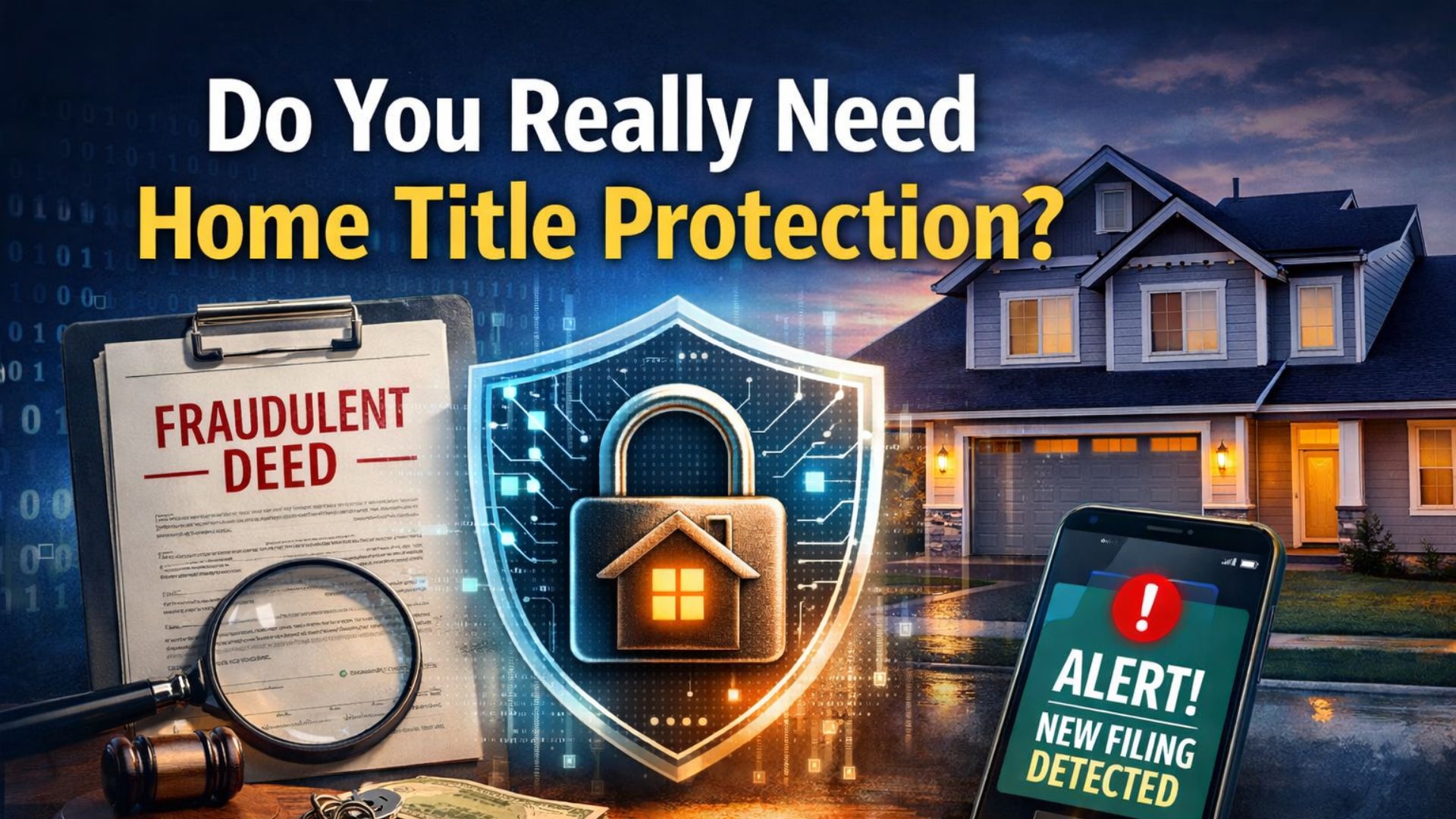
Do You Need Home Title Protection?
Not every homeowner needs a paid monitoring service. The real question is whether your property, your equity position, and your ability to monitor public records make title monitoring worth it for your situation.
Need broader monitoring than basic county-record alerts?
See how HomeLock is positioned for homeowners who want broader property fraud monitoring and clearer next-step guidance.
See how HomeLock worksThis is a decision guide, not a generic category explainer. The goal is to help homeowners decide when title monitoring may be useful, when free safeguards may be enough, and which risk profiles deserve closer attention.
Table of contents
- Do you really need home title protection?
- When is monitoring worth paying for?
- Who is most likely to benefit?
- When free county alerts may be enough
- Why title insurance is not the same thing
- How to decide what fits your risk
- When homeowners compare broader monitoring
- FAQ
- Quick takeaways
- Sources
Do you really need home title protection?
Not always. Some homeowners hear dramatic marketing and assume every property owner needs the same level of monitoring. That is the wrong frame. The better question is whether you would quickly notice suspicious property-related activity on your own, and whether your property profile makes delayed detection more costly.
For some owners, basic habits and free alerts may be enough. For others, especially owners of mortgage-free homes, rentals, second homes, vacant land, or inherited properties, a monitoring service may be more justified because suspicious filings or impersonation issues can go unnoticed longer.
In other words, this is not a yes-or-no question for everyone. It is a fit question based on exposure, visibility, and response speed.
When is monitoring worth paying for?
Home title protection is more likely to be worth paying for when you want faster awareness than manual checking, or when your property setup creates blind spots. Monitoring is typically about visibility, not prevention. That still matters, because earlier awareness can make response easier than discovering a problem much later.
It may be worth it when:
- You do not actively monitor county records yourself.
- You own property with substantial equity or no mortgage.
- You are not living at the property full-time.
- You own inherited, vacant, rental, or second-home property.
- You want alerts and guidance instead of relying only on occasional manual checks.
It may be less necessary when:
- You closely monitor local property records yourself.
- Your county already offers reliable alert coverage that fits your needs.
- Your property is owner-occupied, easy to watch, and not unusually exposed.
- You are comfortable handling occasional manual checks without automation.
Monitoring is usually not a literal lock on your title. It is generally about alerting you to suspicious changes, filings, or signals so you can investigate faster.
Who is most likely to benefit?
The strongest candidates for monitoring are usually homeowners whose properties are easier to exploit quietly or harder to watch consistently.
- Mortgage-free owners: paid-off homes with high equity may attract more attention because there is no lender actively watching title activity.
- Vacant-property owners: empty homes and vacant land are easier targets because suspicious activity may sit unnoticed longer.
- Second-home owners: distance reduces visibility and slows response.
- Rental-property owners: owners are not always present to notice unusual listings, claims, or filing-related issues quickly.
- Inherited-property owners: ownership complexity and stale records can create more confusion and more risk.
- Elderly or less digitally active owners: delayed awareness can make correction harder.
This is where a decision-stage page should live: not “everyone needs this,” but “some owners have more reason to care than others.”
When free county alerts may be enough
Some counties offer free alert programs that notify homeowners when a document is recorded under a property owner’s name. For lower-risk owners, those programs may be good enough as a first layer.
But free county alerts are not identical everywhere. Matching may be name-based, timing may vary, and coverage may be narrower than what some homeowners want. That is why many homeowners end up comparing county alerts with paid monitoring before deciding what level of visibility they actually need.
If you want a more general explanation of what these services are, start with this guide to what home title protection means and how it works.
Why title insurance is not the same thing
One reason homeowners get confused is that title insurance and title monitoring solve different problems. Title insurance is generally about certain defects or issues tied to the title before you bought the property. Monitoring services focus on suspicious activity or recorded filings that appear after you already own it.
That means a homeowner deciding whether to pay for monitoring should not ask whether it replaces title insurance. It does not. The real question is whether you want ongoing visibility into new title-related or property-related issues after closing.
How to decide what fits your risk
A cleaner decision process is to ask yourself a few practical questions instead of reacting to fear-based marketing.
- Would I quickly know if a deed, lien, or ownership-related filing appeared on my property?
- Do I rely only on occasional manual checks, or do I want automated visibility?
- Is this property vacant, inherited, rented, or otherwise harder to monitor?
- Is the property mortgage-free or high-equity?
- Would free county alerts cover enough, or do I want broader monitoring and context?
If your honest answer is that you would not notice a problem quickly, the case for monitoring gets stronger. If you already have strong visibility and lower exposure, a paid service may be less necessary.
Want to compare a broader monitoring approach?
Review how HomeLock is positioned for homeowners who want more than a basic county-record alert model.
Compare HomeLockWhen homeowners compare broader monitoring
Some homeowners do not just want notice after a document is recorded. They want broader property fraud monitoring, more context around suspicious activity, and clearer next-step guidance if something looks wrong.
That is usually the point where a user moves from education into solution comparison. For readers who decide they do want broader ongoing protection, the right next step is to see how HomeLock works.
For readers who are still in prevention mode, a related next read is practical steps to reduce title-theft risk.
FAQ
Do you really need home title protection?
Not every homeowner does. The better question is whether your property profile and your ability to monitor public records make ongoing monitoring worthwhile.
Who is most likely to benefit from home title monitoring?
Owners of mortgage-free homes, vacant properties, rentals, inherited properties, second homes, and other high-equity properties often have stronger reasons to consider it.
Are free county property alerts enough?
Sometimes. In some areas they may be enough for lower-risk owners, but coverage and timing vary, which is why some homeowners compare them with broader monitoring services.
Does home title protection stop fraud from happening?
Usually no. These services are generally about detection and alerts, not preventing someone from attempting to file documents in the first place.
Is home title protection the same as title insurance?
No. Title insurance and title monitoring address different problems. One is generally tied to pre-existing title issues, while the other is about ongoing visibility after ownership.
When is home title protection worth paying for?
It is more likely to be worth paying for when your property is harder to monitor, has higher exposure, or when you want broader visibility than occasional manual checks or basic county alerts provide.
Quick takeaways
Sources
- Federal Bureau of Investigation: Internet Crime Report 2022
Disclaimer: This page is for educational purposes only and does not provide legal advice. If you believe your property records have been affected by fraud, contact your county recorder or clerk and a qualified attorney promptly.