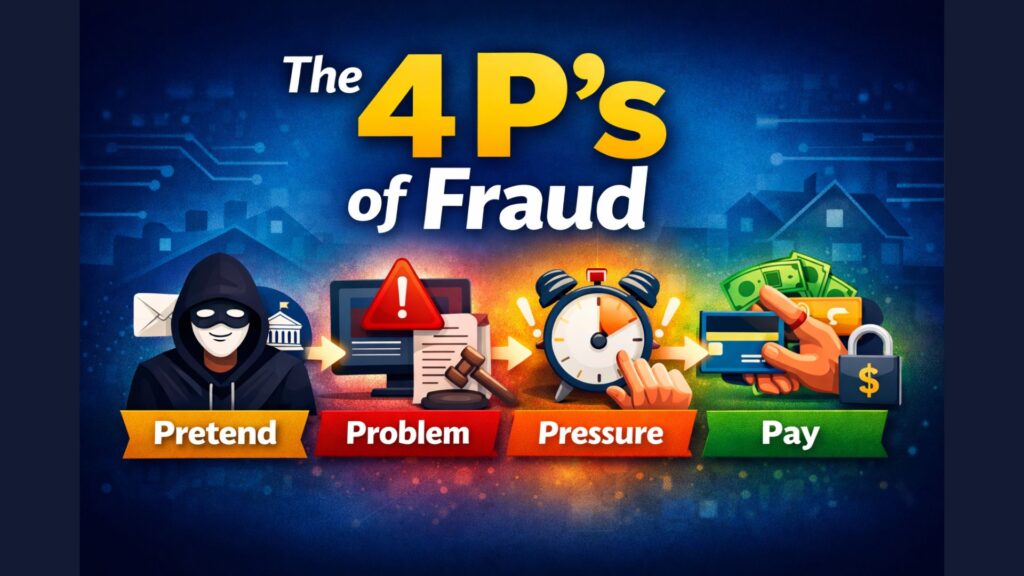
What are the 4 P's of fraud?
Learn the 4 P’s of spotting fraud: pretend, problem, pressure, and pay, plus practical ways homeowners can reduce risk and avoid common scams.
The 4 P’s (often called the “4 P’s of spotting fraud”) are pretend, problem, pressure, and pay. They’re a simple checklist to help you recognize common scam tactics and avoid becoming a victim.1
Table of contents
What are the 4 P’s of fraud?
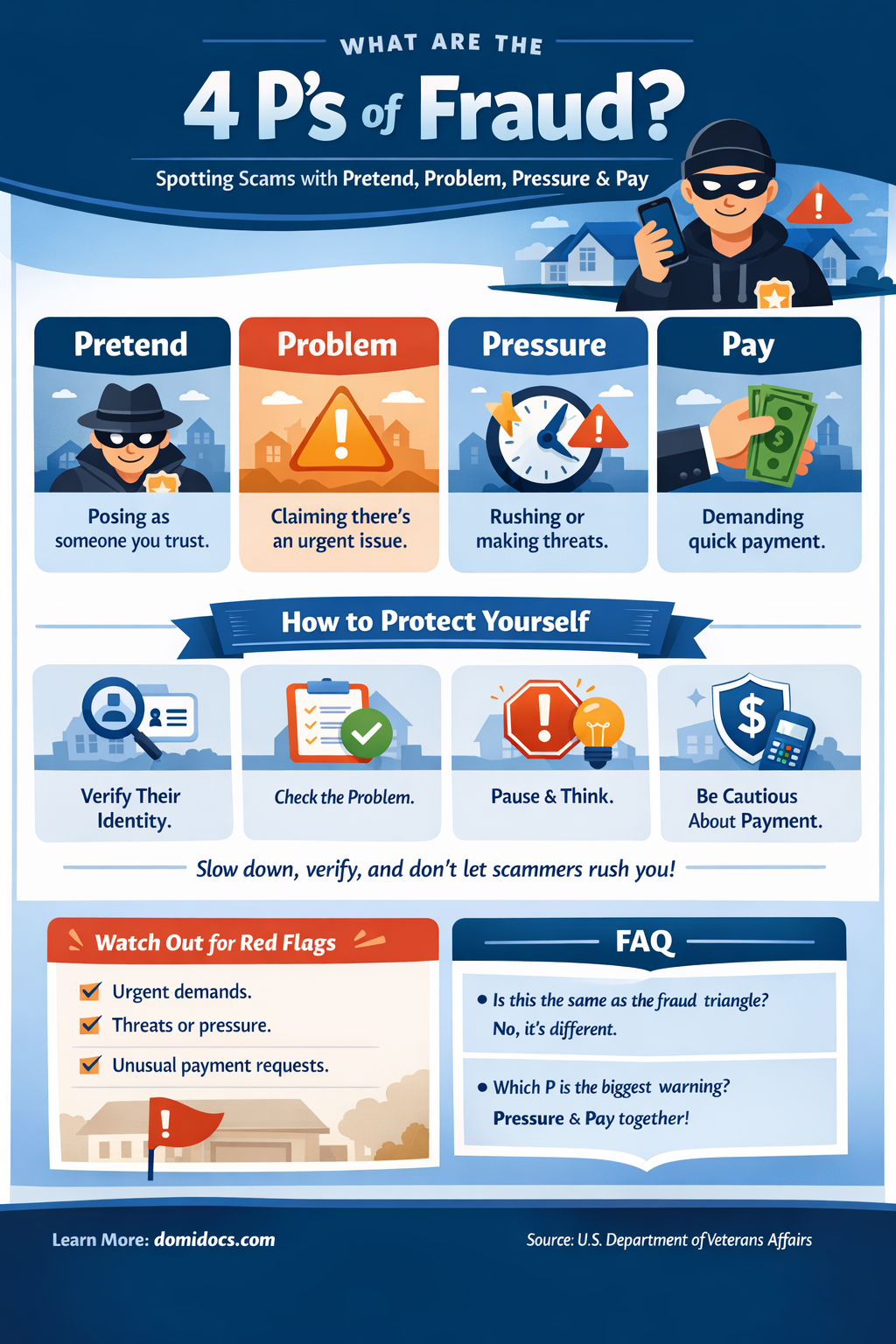
The “4 P’s” is a practical way to remember four signals that show up in many scams:
- Pretend: Scammers pretend to be a trusted organization or person to gain your trust.1
- Problem: They claim there’s an urgent problem (legal trouble, account issue, benefit problem) to alarm you.1
- Pressure: They apply time pressure or threats to stop you from thinking clearly or verifying details.1
- Pay: They push for a payment method that’s hard to reverse or trace (or ask for sensitive information).1
Note
This is different from the “fraud triangle” or “fraud diamond” used in auditing (pressure, opportunity, rationalization, plus capability). Those frameworks explain why fraud happens inside organizations. The 4 P’s here are meant to help everyday people spot scams.
P #1: Pretend
Pretend is the identity hook. The scammer impersonates an agency, bank, title company, lender, charity, or even a local official to sound legitimate and lower your guard.1
P #2: Problem
Problem is the fear hook. The scammer claims something is wrong, like your account is locked, your benefits are at risk, there’s a warrant, a fee is overdue, or a property record “issue” needs immediate action.1
P #3: Pressure
Pressure is the urgency hook. They may say you must act “right now,” threaten consequences, or tell you not to contact anyone else. The goal is to prevent you from verifying the story.1
P #4: Pay
Pay is the extraction hook. They’ll try to get money or sensitive information, often steering you toward options that are difficult to recover (or difficult to dispute) and away from safer, slower verification steps.1
Why the 4 P’s matter for homeowners
Homeowners are frequent targets because property, identity, and financial accounts intersect. Scams often start with impersonation, escalate into urgency, and end with a request for payment or personal information.
How to reduce fraud risk using the 4 P’s
Use the 4 P’s as a quick filter before you respond:
- If you see pretend, independently verify who you’re dealing with using official contact info (not what they provide).
- If you hear a problem, pause and validate it through your own channel (log in directly, call a known number, check official notices).
- If you feel pressure, treat it as a red flag and slow down.
- If they demand you pay in a specific way or share sensitive info immediately, stop and verify first.
If you suspect an issue, see what to do if you suspect title fraud .
Real-world examples of the 4 P’s in action
Most scams follow the same pattern:
- Pretend: “I’m calling from your county records office.”
- Problem: “There’s an urgent issue with your property record.”
- Pressure: “If you don’t fix it today, you could lose your home.”
- Pay: “Pay this fee now or share your information to ‘confirm ownership.’”
FAQ
Are the 4 P’s of fraud the same as the fraud triangle?
No. The 4 P’s here (pretend, problem, pressure, pay) are a scam-spotting checklist. The fraud triangle is an auditing framework (pressure, opportunity, rationalization).
Which of the 4 P’s should I treat as the biggest red flag?
Pressure and pay together are especially suspicious. Urgency plus a demand for money or sensitive info is a common scam pattern.
Sources
- U.S. Department of Veterans Affairs (VA) Privacy Service. The Four P’s of Spotting Fraud